Sunday Times of Malta
16th December 1945 Pages 5 and 12
MEN WHO SWEEP THE SEAS
Their Contribution To Battle Of The Peace
MALTA'S MINEFIELDS ARE 80 PER CENT CLEARED
by F. Hudson, "Times of Malta" staff reporter and photographer
The first two articles of this series dealt with the war record in the Mediterranean of the 19th Minesweeping Flotilla and Allied cooperation in the shape of mine spotting assistance from a United States Navy blimp. This week's article deals with the international side of mine clearance and closes with a tribute to those 'men of the minesweepers' who 'went before':
THE MEDITERRANEAN IS A FOCAL POINT OF THE WORLD'S SEA TRADE AND IT FOLLOWS THAT THE HARD AND PRACTICABLE BUSINESS OF THE CLEARING OF THESE WATERS OF MINES, BOTH ENEMY AND ALLIED LAID, NATURALLY AFFECTS THE SEA TRADE OF THE WORLD.
The end of hostilities in Europe brought with it the announcement that the formidable total of 100,000 mines had been laid in the Mediterranean since 1940, some 72,000 of them in the central area. How they were to be cleared was laid down by the International Mine Clearance Board, meeting in Naples to discuss post-war mine clearance in European waters, and it has become an established principle of international agreement that the respective Powers are to be responsible for mine clearance in their own waters.
In so far as this affects the Mediterranean Powers, the Royal Navy and the Royal Air Force, together with Allied sea and air forces, made so effective their destruction in enemy-held ports up and down the Middle Sea, that very few suitable craft remain available to nations such as Italy, France (through Vichy France) and Greece.
NAVY'S MANY COMMITMENTS
Thus, apart from the Royal Navy's commitments in the British zones, namely Malta, the approaches to Gibraltar, the north coast of Cyrenaica and the approaches to Alexandria, and in addition keeping open the war channels for international shipping supporting U.N.R.R.A.'s relief of a starving continent, British minesweeping flotillas are assisting the Italians, the French and the Greek in the clearance of their respective areas.
It also fell to the 5th and 12th Minesweeping Flotillas of the Royal Navy to sweep the approaches to the Dardenelles, clearing the way for ships going through the Straits to the momnetous 'Big Three' conference in Yalta, on the Black Sea. In December-January 1945, and they 'bagged' 188 mines in that operation but now, after training with the Royal Navy, the Turks have a small flotilla of their own with which they hope to complete operations.
INTERNATIONAL ROUTING AUTHORITY:
Meanwhile, as this vast task proceeds apace - it is estimated that some 40,000 mines remain to be cleared in the whole of the Mediterranean, including the Aegean, Adriatic anf Tyrrhenian Seas - a word-wide international routing authority continues to provide routes and navigational aides to merchant ships throughout the world, the route being amended accordingly as channels are widened and minefields cleared. Thus, the chance today of individually routed merchantmen striking a mine is very remote and those cases that have occurred are, in most instances, attributed to the fact that the vessel has strayed from a set course.
MALTA'S TERRITORIALWATERS:
An overall picture of mine clearance in the Mediterranean shows that all channels have been cleared and a start has now been made on the minefields either side of those channels. In regard to Malta, it can be said authoritatively that her territorial waters are 80 per cent cleared with a total 'bag' of 560 mines of all types.
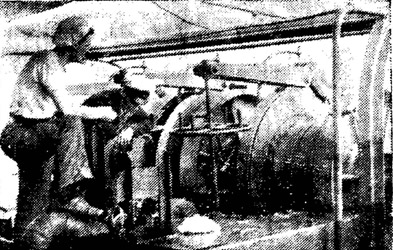 |
| WATCHING THE SWEEP WIRE: At the winch aboard H.M.s. RINALDO are Stoker "Bill Briggs, of Newcastle on Tyne and Chief Petty Officer Henry Leek, of Gillingham, Kent. |
302 SQ. MILE MINEFIELD:
The 19th Minesweeping Flotilla, under Commander F.S. Walford, R.N., has been engaged in sweeping a three year-old minefield some 302 square miles in area to the east of the island. The flotilla has swept some 250 square miles of the minefield when I was allowed to accompany them and, up to that period, had reported a 'negative sweep.' Enquiry as to why this should be produced the reply that mines laid for any great length of time invariably became waterlogged and sink to the bottom where their only source of menace, provided the mine's mechanism is still in order, is to ships anchoring in that area, which is extremely unlikely. It was pointed out that a mine can, and sometimes does, break away from its mooring to become a drifting menace. That contingency has been allowed for in British mines in that they are automatically rendered safe the moment they part company with their mooring wire. On the other hand, the enemy has been found lacking in compliance with this rule laid down by the Hague Convention. Thus the hazard of the drifting mine however remote, has to be accepted by all who sail the seas for a good few years to come.
19th DUE FOR A WELL EARNED REST
The 19th Minesweeping Flotilla has returned to Malta this week-end at the close of another week's hard toil (latterly assisted by the 12th Flotilla) in very rough seas, to hand over the task to the 5th Flotilla which, led by Commander H.J. Jenkins, D.S.C., R.N., in H.M.S. Welfare, has been operating in some of the most heavily mined areas in Greek waters since June 1944.
The 19th Flotilla leave this week for Alexandria and a well earned rest and while expressing the whole of the island's gratitude and thanks for an arduous task well done, it is surely not inopportune to recall, in tribute, the efforts of the 'men of the minesweepers' who 'went before,' for their's is indeed, a grim roll of honour.
BLITZ DAYS RECALLED
All in Malta will recall the days when the local ferries could not cross the creeks until a brave little drifter, flying the White Ensign and with magnetic sweep trailing far behind, had patrolled those creeks, and how the Fleet sweepers "Rye" and "Hythe", covered by "Speedy" and "Hebe" towed Captain Mason's sinking and blazing tanker "Ohio" loaded with fuel for Malta's fighters, from under the guns of Pantalleria, in addition to their normal day's sweeping of the Malta Channel under constant air attack.
MALTA MANNED:
Many of the drifters and smaller vessels were manned by Maltese naval ratings: H.M. Tug St. Angelo mined and sunk in May 1942: H.M.Drifter Eddy struck two mines and sunk in the same month: H.M.Drifter Trusty mined and sunk in the June of this year along with H.M.Drifter Justified mined and sunk off the Great Harbour. The boom vessel Moorstone lost in two minutes inside the Grand Harbour with a heavy toll of lives: the minesweeper Abingdon shot up by Messerschmits off Filfia and eventually bombed and sunk in the Grand Harbour. The destroyer H.M.S. Matchless damaged by a mine in June 1942 together with H.M.S. Badsworth in the same month. Fleet Minesweeper Hebe damaged by a mine June 15, 1942 (she was lost eventally off Bari during the invasion of Italy) the Kujawak mined and sunk on the same day and the M/V Orari mined and damaged the following day.
Fleet minesweeper Speedy mined and damaged nort-east of Valetta on May 15 1943: the Hythe torpedoed and lost off Cape Bon while escorting a convoy and, later, the monitor Abercrombie mined in August 1944. Commander Temple, (the present Commander, Minesweeping Malta) in the minesweeper Cava, accompanied by Juliet and Strome, raced to her assistance, disposing of several mines on the way and then swept Abercrombie in to harbour, an operation which earned for Commander Temple the D.S.C.
Many will remember the trawlers Girl Margaret, and Ploughboy, both sunk after marathon work in disposing of magnetic and acoustic mines. Later they were raised, recommissioned and served the fleet as store carriers before being returned to the United Kingdom to rejoin the fishing fleets. Another veteran - Swona - has rejoined the South African fishing fleets. There was also the 3rd Flotilla of M.L.'s who after their magnificent dash through the Western Mediterranean disguised as Italian E-Boats, accomplished stirling feats of inshore shallow sweeping, accounting for innumerable mines in the bays
Throughout the Royal Navy's long assocition with Malta there can be few chapters of high tradition, valiance and self-sacrifice than that provided by the 'Men who sweep the Seas.' |


